
 Casework has a method. Enyalius is built around it.
Professional case management for people, risk and compliance. Enyalius gives an organisation a structured, auditable way to run complex workplace matters, without replacing the professional judgement those matters turn on.
- Thirty-one workflows
- Decisions gated to authorised people
- History that is added to, never edited away
01 Why Enyalius
A ticket queue holds the case. It does not hold the method.
Casework is a professional discipline with an order to it. In most organisations that order survives in two or three experienced heads, while the case itself lives somewhere else entirely.
Establish the concern, work out what kind of matter it is, gather what is relevant, put it to the person, hold the meeting, decide, record why, offer the appeal. Practitioners learn that order over years, and the consistency of it is most of what makes a matter manageable rather than memorable.
Software has offered two answers to this, and neither respects the work. A ticket queue holds the case but not the method: it tracks status and ownership, and is indifferent to whether the right steps were taken in the right order. Automation goes further and displaces the practitioner, producing outcomes from answers and scores. The first leaves the professional unsupported. The second leaves the organisation unable to explain, months later, why a decision was actually made.
Enyalius takes the third position. It holds the method and protects the judgement, and the record is built as the work is done rather than reconstructed once it is challenged.
02 Built around human decisions
The system holds the method. The professional holds the judgement.
Enyalius is deliberately not autonomous. The prohibition on automatic decision-making is enforced in the product as a validated rule, rather than stated as a policy and hoped for.
Stages guide the work. Evidence is surfaced at the point it is needed. Where a matter turns on a decision, the workflow reaches a human gate and stops there, and four things must be true at once before it opens.
- Authorised
- The person acting holds an active, authorised role for this case.
- Evidenced
- The evidence the stage requires is linked, or explicitly marked not applicable with a reason. Evidence that is merely unavailable leaves the gate shut.
- Declared
- The decision is an exact option the workflow declares, not free text.
- Reasoned
- A rationale is recorded before the case moves on. Where an override is permitted, it is recorded with its reason.
Nothing progresses because time passed. A wait that expires does not select a route. No answer, no score and no elapsed period produces an outcome. Consent is never inferred. Templates are suggested; they are not sent. Deadlines prompt; they do not decide.
Enyalius does not make employment or legal decisions, and it is not intended to. It makes the decision visible, attributable and capable of being explained. This will not make a difficult matter easy. It makes your position legible while the matter is live, and capable of being shown once it has closed.
03 Coverage
Thirty-one workflows, grouped the way practitioners think.
Thirty specialist processes, grouped below, and the intake workflow that every new matter starts on. Each carries its own stages, its own evidence expectations and its own decision points. It is the range a growing organisation meets most often, not a claim to have anticipated everything.
04 What it looks like
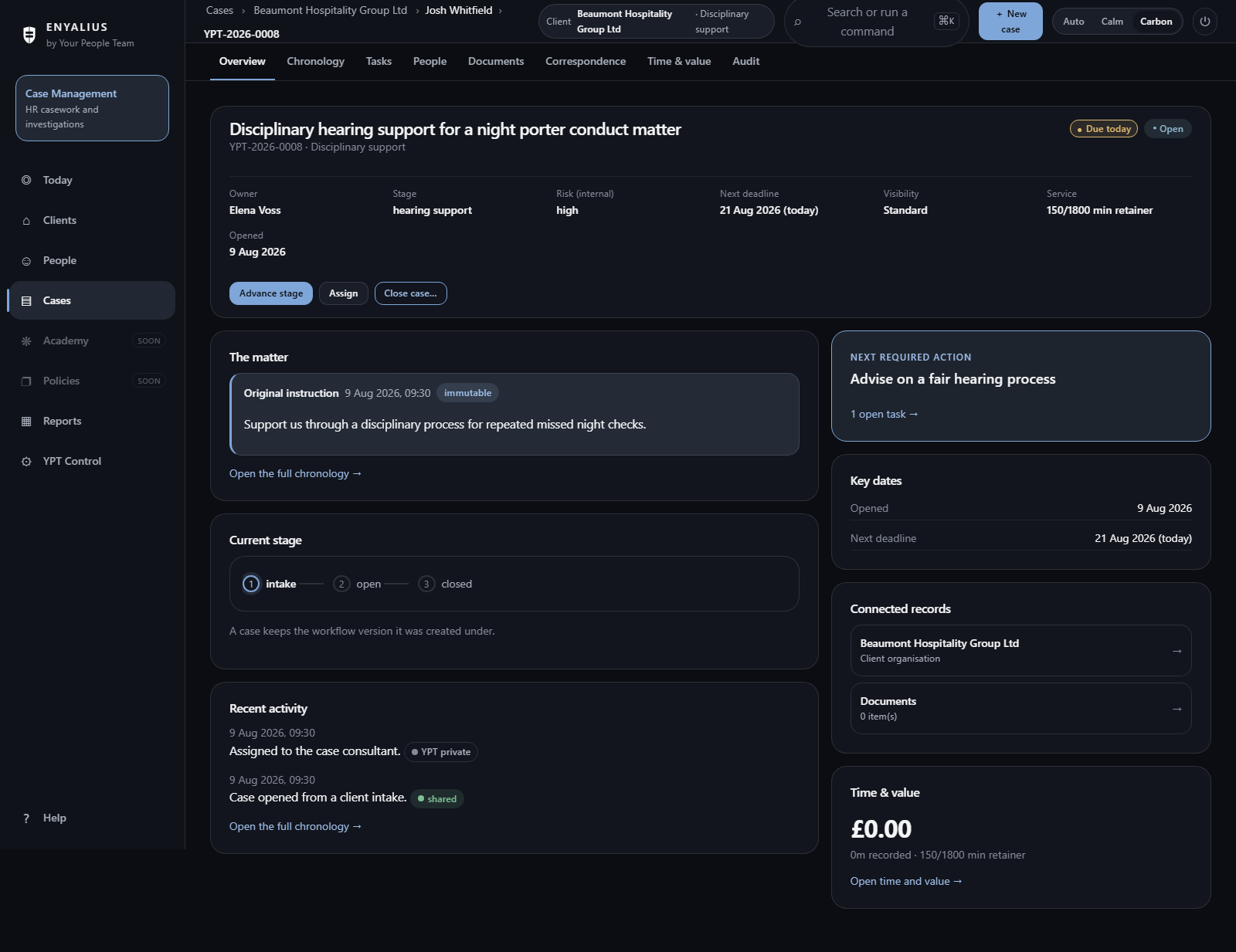
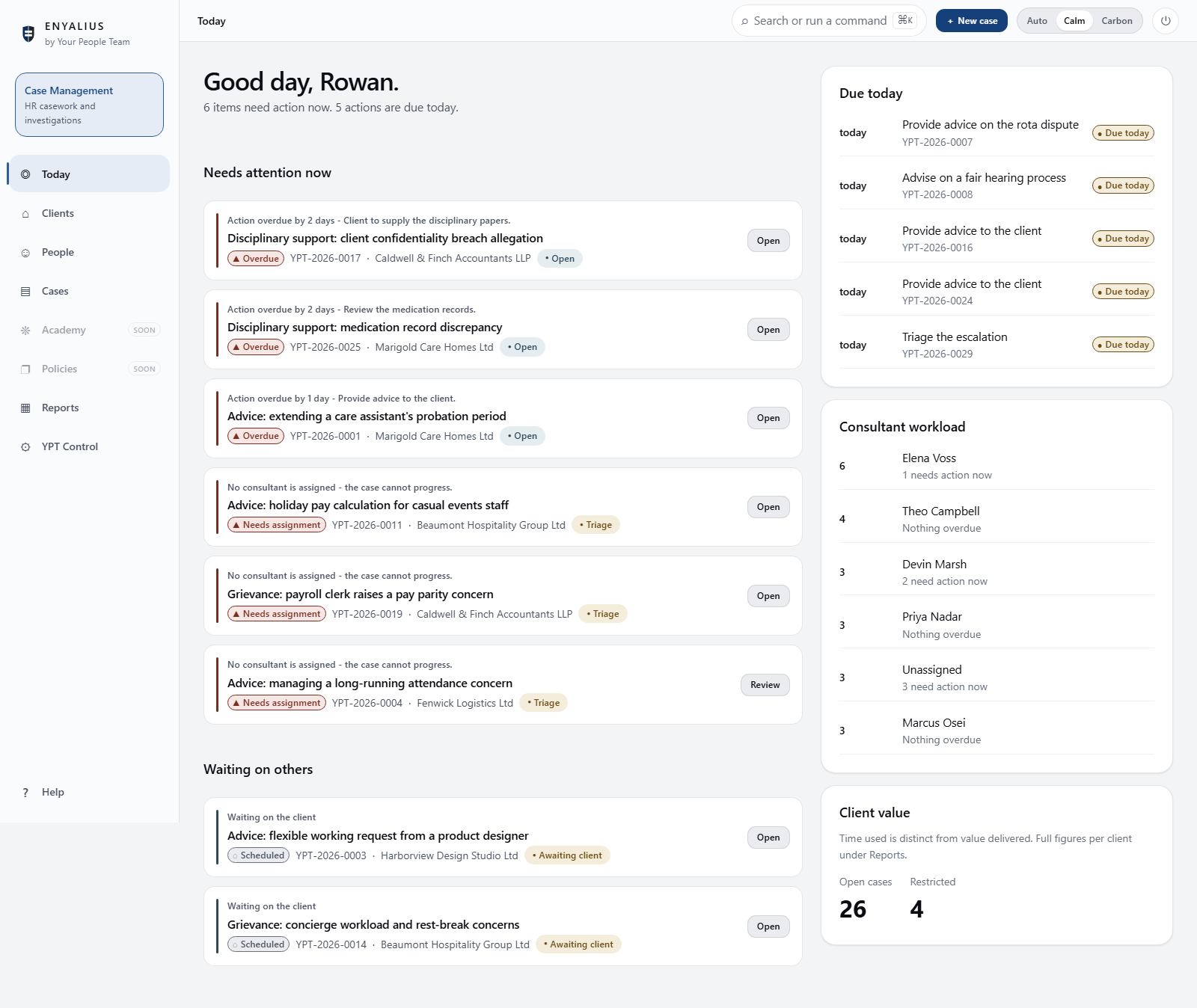
The record, while the work is happening.
Two views of the build as it stands today. Both run on synthetic data: fictitious organisations, fictitious people, and matters written for a demonstration.
05 From manager to specialist
A manager should not have to know which process applies.
Most matters begin with a line manager who knows something is wrong and does not yet know what it is. Asking that manager to classify it is where organisations lose time.
-
The manager raises a request
A line manager submits a plain HR support request describing what has happened. They are not asked to choose a procedure, and they are not asked to name the matter. -
Enyalius opens the case
The request creates a case on the intake and routing workflow in a single step, so nothing is raised that is not also recorded. From that moment the matter has an owner, a chronology and a clock. -
An authorised person selects the process
Someone qualified to judge it selects which of the thirty specialist workflows applies. Automatic traversal from intake into a specialist workflow is prohibited: no rule, keyword or score moves a matter into a disciplinary or a grievance path.
Sensitive professional controls stay where they belong. Access follows a deny-by-default model across six roles, so a manager sees the matters they raised, took part in, or that have been deliberately shared with the organisation for people in their scope, not the professional case environment around them. A manager who raised a concern does not thereby acquire sight of the investigation into it, and nothing becomes visible merely because someone forgot to restrict it.
06 Communications and forms
Approved wording, at the right stage, prepared for a person to read.
Correspondence is where good casework is most often let down: the wrong letter, the wrong version, the wrong date, or a paragraph that was never meant to survive the last redraft.
Enyalius holds 271 published communication templates, each mapped to the workflows and stages it belongs to. Templates are immutably versioned, and a draft pins the exact version it was prepared from, so the wording you relied on remains the wording you can produce.
Merge fields are resolved on the server from a typed registry. Where
a field cannot be resolved, the draft carries a visible
[REQUIRED — field name] marker rather than an empty
space or a plausible guess. A gap is shown rather than quietly filled.
Drafts are prepared for human review and are never sent by the system. There is no send operation and no queue anywhere in the product. That is a deliberate design decision rather than an unfinished feature: the decision to issue correspondence in a live matter belongs to a person who has read it. Enyalius prepares wording. It does not produce a finished document file, and it is not a document store.
07 Designed for growing organisations
The method matters most where there is no HR function to hold it.
Large organisations carry their casework method in a team. Growing organisations carry it in one or two people, and it leaves when they do.
Enyalius supplies the structure that a larger HR function would otherwise hold in habit and memory. It is built for organisations that have outgrown informal process but do not have a specialist on every site or in every week: ownership, deadlines and history attach to the matter rather than to whoever happened to pick it up.
It also reflects how we work. Enyalius was developed by Your People Team out of consultancy casework rather than from a product brief, and it is designed to sit alongside advice rather than to replace it. The intention is that the case environment and the advice describe the same matter, in the same terms.
It will not be the right answer for everyone. If your matters are infrequent, or if what you need now is a clear, practical policy rather than a case environment, we will say so.
08 Security and assurance
What is built, and what is not claimed.
Casework holds some of the most sensitive information an organisation keeps. We would rather describe the controls that exist than the impression they create.
Built into the product
- tenant separation, with organisation scoping enforced on every route, and row-level security written for the hosted target but not yet exercised against a live database;
- a reference to another organisation's record answered with a uniform 404 and never a 403, so the response does not confirm that the record exists;
- a deny-by-default role and capability model across six roles;
- restricted investigations sealed below read, with full content released only by a stamped case-team grant;
- an immutable case chronology, an append-only audit trail and an immutable workflow transition history;
- attributed, immutable configuration version history, with overrides recorded against a reason;
- human-gated progression, enforced as a validated rule rather than left to convention.
What we do not claim
- no certification is held: not ISO 27001, not Cyber Essentials, not SOC 2;
- no external sending or delivery of anything, whether email, letters, notifications or reminders;
- no integrations with occupational health, legal, regulatory, payroll, messaging or identity providers;
- no document rendering service and no production file storage;
- no artificial intelligence and no automated decision-making anywhere in the product;
- no production deployment, and no named customers, adoption figures, uptime claims or testimonials, because there are none to give.
Your People Team does not provide penetration testing, digital forensics or managed cyber security services. Where specialist technical work is required, we help define the organisational need and work alongside appropriately qualified providers. Enyalius records what was done, by whom, when and on what basis. It does not certify that the decision was correct. That remains a matter of professional judgement, and it is meant to.
See it against a case you already know.
The most useful demonstration is not a tour of the screens. Think of a matter you have already closed, and we will walk through how Enyalius would have carried it: the stages, the evidence, the correspondence prepared for review, and the points where the system stops and asks an authorised person to decide and to say why. Nothing of yours is entered into the demonstration. You will see the limits as clearly as the capabilities, which is rather the point.